
May 5, 2026
The 2026 Tech Stack for Australian F&B Wholesale Growth
A practical guide to the tools that fast-moving food and beverage wholesalers are building their operations around — from accounting to field sales to buyer ordering.
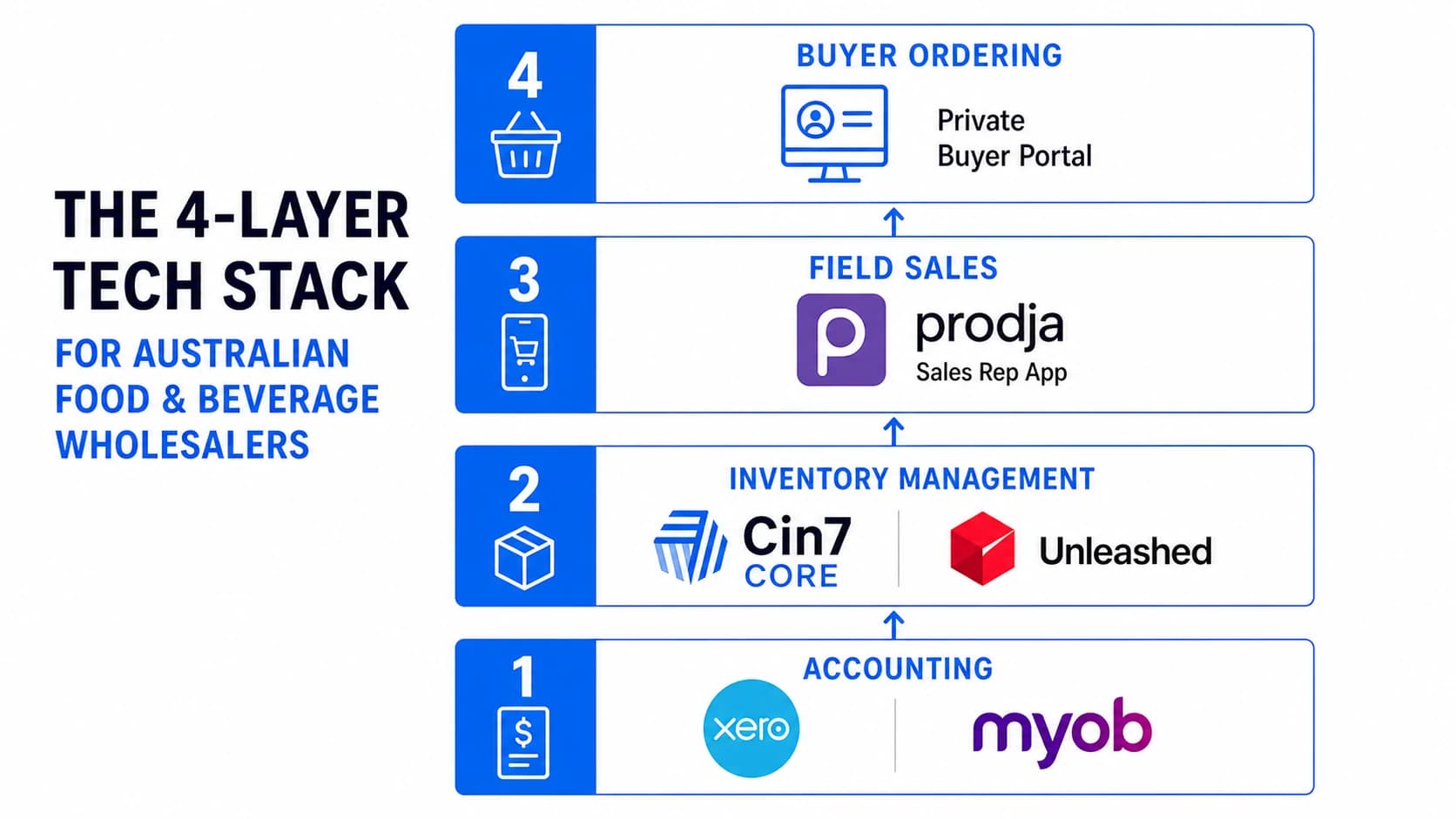
Australian food and beverage wholesale is a sector that runs on relationships, speed, and volume. A rep visits a café at 8am, the buyer places a reorder at 11pm, and by the next morning the invoice needs to be in the accounting system and the pick-list needs to be ready.
Most F&B wholesalers have the relationship part down. The speed and the systems are where the gap shows up.
In 2026, the businesses pulling ahead aren't necessarily bigger or better-resourced — they've just made smarter decisions about which tools to connect together. This guide breaks down the stack layer by layer: what each tool does, who it's for, and how it fits with everything else.
Layer 1 — Accounting: Xero or MYOB
Every other tool in this stack ultimately feeds into your accounting system. Get this layer right first.
Xero is the dominant choice for F&B wholesale businesses that have modernised in the last five years. Its cloud-first architecture, open API, and the depth of its Australian app ecosystem make it the natural foundation for everything else in this stack. If you're setting up from scratch, start here.
MYOB remains widely used — particularly among established businesses that have been operating for more than a decade. MYOB AccountRight and MYOB Business are both viable, and the integrations available have improved significantly. If your business is already on MYOB and your team knows it well, there is no compelling reason to migrate.
What matters most: whichever you use, every other tool in the stack should sync to it automatically. If any tool requires a manual export, a CSV import, or someone copying data between systems, that tool is costing you hours every week and introducing errors into your books.
Layer 2 — Inventory Management: Cin7 Core or Unleashed
F&B wholesale businesses need real-time visibility over stock. Which products are running low, which are available to promise to a new buyer, and what needs to be ordered from your supplier — these are operational questions that the accounting system alone cannot answer.
Cin7 Core (formerly DEAR Systems) is purpose-built for businesses that deal in physical goods. It handles purchase orders from suppliers, inbound stock receipts, inventory levels across locations, and sales order management. It connects to Xero and MYOB natively.
Unleashed is another strong option with a long track record in the Australian market. Similar feature set to Cin7 Core, strong Xero integration, and particularly well-regarded by businesses with straightforward inventory needs who want a clean interface without the complexity of a full ERP.
Starting from scratch? Don't skip this layer. Running stock in a spreadsheet is manageable at low volume. By the time it becomes a problem — stockouts, over-selling, suppliers waiting on accurate forecasts — it's already costing you customers.
Layer 3 — Field Sales Ordering: A Mobile Rep App
This is the layer most F&B wholesalers still haven't solved.
The inventory system manages the back-end. The accounting system handles the books. But when a rep walks into a café at 8am to take the week's order, what happens next? In most businesses: a phone call back to the office, a WhatsApp message, or a note scribbled and entered later.
A purpose-built mobile sales rep app closes this gap. The rep opens the app, finds the customer, browses the catalogue with that customer's negotiated pricing already applied, and places the order on the spot — before leaving the premises. The order appears in the management hub in real time. Nothing to call in. Nothing to re-enter.
For F&B wholesale specifically, this matters because the rep visit cadence is high — a single rep might visit 15–25 accounts in a day. At that volume, the time lost to manual order entry and phone call-ins compounds quickly.
A good rep ordering app also handles:
- Promotional codes applied at the point of order
- GPS check-in to log the visit against the customer record
- Quote creation — send a quote to a buyer directly from the app; the buyer receives an automated email to approve, decline, or request changes
- Full order and quote history per customer
- Direct sync to Xero or MYOB so every order automatically becomes an invoice
Layer 4 — Buyer Self-Serve: Private Portal + Network Ordering
This is where the F&B stack gets interesting — because there are two different buyer ordering problems, and they need different tools.
Your existing buyers ordering between rep visits
Your regular accounts — the café that orders every Tuesday, the restaurant that tops up on Friday morning — don't always want to wait for the next rep visit or call your team to place a routine order. They want to order at 11pm when they're reconciling their week.
A private B2B buyer portal gives each of your buyers a login to your branded ordering page. They see their negotiated pricing, browse your catalogue, and place orders directly. No phone call needed. Orders go straight into your management system and sync to Xero or MYOB. This is a direct channel between you and your existing customers that you own.
Getting discovered by new buyers
Ordermentum and Upstock are buyer ordering networks used by thousands of hospitality businesses across Australia. A café that orders from eight different suppliers may do all eight orders through a single Ordermentum login. If your business isn't on the platform, you're invisible to that buyer.
These platforms solve a different problem from a private buyer portal — not the management of your existing buyer relationships, but the discoverability and convenience for new ones. Joining one (or both) puts your products in front of buyers already using the platform.
How they fit together:
| Channel | Tool | Best for |
|---|---|---|
| Existing buyers, repeat orders | Private buyer portal | Direct, branded, owned |
| New buyer discovery | Ordermentum / Upstock | Hospitality network reach |
| Rep-placed orders | Mobile sales app | On-site visits |
| All orders → accounting | Xero / MYOB | Automatic via integration |
Running a private portal alongside Ordermentum is not duplication — they serve different moments in the buyer relationship. A new café finds you on Ordermentum and places their first order there. Once they're an established account, they get a portal login and the relationship deepens into a direct channel you own.
How It All Connects
The most important thing about this stack is that it's connected. An order placed anywhere — by a rep in the app, by a buyer on your portal, or by a buyer on Ordermentum — flows into your management system and generates an invoice in Xero or MYOB automatically. Your stock levels update. Your books stay accurate. Nobody re-enters anything by hand.
For a 10–40 person F&B wholesale business, the combination typically looks like:
- Xero (or MYOB) as the accounting foundation
- Cin7 Core or Unleashed for stock and inventory
- A mobile sales rep app for field ordering and a private buyer portal for self-serve ordering
- Ordermentum or Upstock for hospitality buyer network access
The full stack is achievable on a budget that compares favourably to hiring one additional admin person to process manual orders — and it runs around the clock.
Where to Start
If you're building this stack from scratch, the order matters:
- Set up Xero or MYOB first. Everything else integrates with it.
- Add Cin7 Core or Unleashed. Get your stock and purchasing in order before digitising your sales process.
- Add a rep ordering app and buyer portal. Your reps get the mobile app, your buyers get the portal. Look for a tool that includes white-glove setup — your catalogue and customer list should be imported for you.
- List on Ordermentum or Upstock once your internal operations are clean. You want to be able to fulfil the orders that come in before you open a new demand channel.
If you're already partway through this stack, the most common gap is Layer 3: an inventory system and accounting system in place, but reps still taking orders by phone. That's usually where the biggest efficiency gain sits.
Not Sure Where to Start?
If you're partway through this stack and not sure what's missing — or building from scratch and want a second opinion — we're happy to take a look at your current setup and give you an honest answer.